On December 28, 1978, a fully functional airliner ran out of fuel over Portland, Oregon. United Flight 173 had a landing gear indicator light that refused to turn green, so the captain circled while the crew troubleshot it. For about an hour, three experienced aviators poured their attention into one burned-out problem while the fuel gauges wound down toward zero. The flight engineer voiced concern about the fuel — but not forcefully enough to break through. The DC-8 went down in a suburb six miles short of the runway. Ten people died. The landing gear, it turned out, had been down and locked the whole time.
The NTSB’s finding was uncomfortable: nothing on that aircraft failed in a way that should have hurt anyone. The crew failed — not in skill, but in how they worked as a team. That report sparked what became Crew Resource Management (CRM), and it is the reason a first officer today is trained — and expected — to challenge a captain who is flying into trouble.

EMS runs on the same raw material as a flight deck: small teams, time pressure, incomplete information, and hierarchy. Which means we inherit the same failure modes — and can borrow the same fixes.
CRM Is a Skill Set, Not a Personality
CRM is not about being nicer to your partner. It is a set of specific, learnable team behaviors designed to stop normal human factors — fixation, hierarchy, overload, assumption — from reaching the patient. The core precepts:
- Flatten the authority gradient. The steeper the perceived gap between the most and least senior person on scene, the less likely a concern gets voiced — that gradient is what kept United 173’s fuel problem from being said out loud like it mattered. The senior member’s job is to actively lower the slope: “If anyone sees something I’m missing, say it.”
- Speak up with graded assertiveness. Concern has a ladder. A useful one is CUS: “I’m Concerned” → “I’m Uncomfortable” → “This is a Safety issue — stop.” Each rung is a signal that gets progressively harder to wave off. Crews that pre-agree on the ladder hear the alarm in the words, not just the volume.
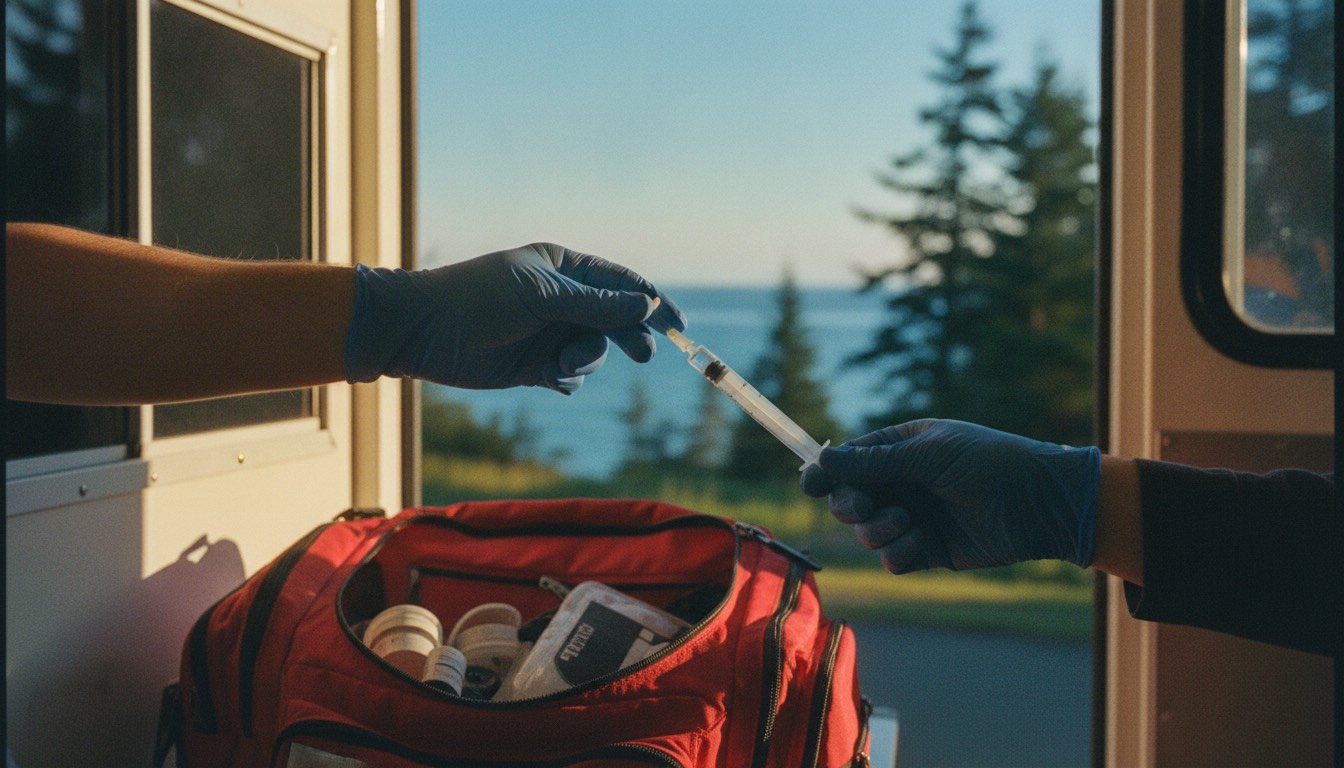
- Close the loop. Orders into the air are orders lost. Direct by name, get a repeat-back, and get a report when it’s done: “Sam, 0.4 of naloxone IM.” — “0.4 naloxone IM.” — “Naloxone’s in.” Three short sentences, and now both of you know what actually happened, not what you each assumed.
- Build a shared mental model. A plan that lives only in your head is not a plan; it’s a private prediction. Verbalize it — “Working assumption is sepsis; we’re moving in five; if the pressure drops we do X” — so the whole crew is running the same movie, and anyone can flag when reality stops matching it.
- Manage workload — and fight fixation. United 173’s deepest lesson: all three crew members dove into one problem, and nobody flew the airplane. The EMS version is the whole crew head-down on a difficult airway while nobody notices the falling pressure. Someone always keeps the wide view. If that’s you, protect it; if you’re task-saturated, say so and hand something off — that’s competence, not weakness.
- Debrief without blame. Two minutes at the tailboard: what went well, what we’d do differently, what surprised us. Crews that debrief routinely get measurably better; crews that only “debrief” after disasters learn only from disasters.
Medicine Already Ran This Experiment
Aviation’s insight crossed into healthcare decades ago — anesthesia rebuilt it as crisis resource management, and resuscitation turned it into pit-crew CPR with assigned roles and closed-loop choreography. The evidence says it transfers: a large meta-analysis of team training across healthcare found improvements not just in teamwork behaviors but in clinical performance and patient outcomes (Hughes et al., 2016). The common thread in the landmark cases, in aviation and medicine alike, is almost never missing knowledge. It’s information that was present on scene — in somebody’s head — and never made it into the team.

Where to Go Deeper
This pearl is the trailhead, not the trail. We’re building a full course — Crew Resource Management & Cognitive Load for EMS — that works through these tools call-by-call: authority gradients, cognitive offloading, challenge-and-response, and how to actually install the habits in a two-person crew. It’s coming to the All-Access library; the outline is up now.
The Pearl
The most dangerous failures on scene are rarely knowledge failures — they’re team failures: a concern unvoiced, an order unconfirmed, a whole crew fixated on one problem while the patient quietly gets worse. CRM is the learnable countermeasure: flatten the gradient, escalate concerns on a ladder (CUS), close every communication loop by name, say the plan out loud, keep one set of eyes on the wide view, and debrief every tough call. The best medic on scene isn’t a person. It’s the crew.
References
- National Transportation Safety Board. Aircraft Accident Report: United Airlines Flight 173, Portland, Oregon, December 28, 1978. NTSB-AAR-79-7. NTSB
- Helmreich RL, Merritt AC, Wilhelm JA. The evolution of Crew Resource Management training in commercial aviation. Int J Aviat Psychol. 1999;9(1):19–32. PubMed
- Hughes AM, et al. Saving lives: A meta-analysis of team training in healthcare. J Appl Psychol. 2016;101(9):1266–1304. PubMed
This clinical pearl is for educational discussion only. Always follow your local protocols and medical direction. Your protocols exist for good reasons — this content is meant to enhance your clinical thinking, not replace your guidelines.